My new translation:
The Dyatlov Pass: Revelations from a KGB Veteran (2024-X-7)
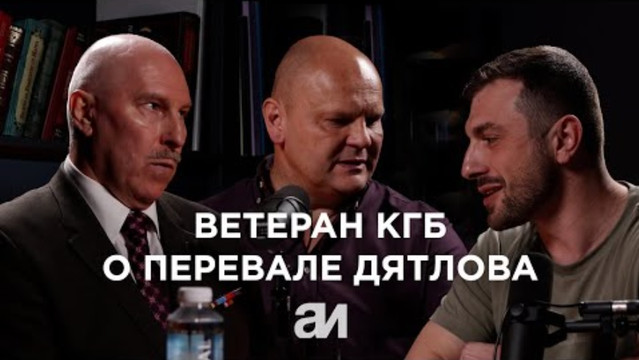
[BABAYEV]: Greetings, friends! It’s me again, Roman Babayev, Editor-in-Chief of *Avtor i*. With me is Ruslan Pankratov, a researcher at the Institute of CIS Countries and our video content editor. Today, we want to discuss a truly mysterious story.
It is a story of the kind that leaves questions unanswered and stirs up dark thoughts. As Arseny Tarkovsky once said:
A riddle without an answer: who will turn back,
Having danced on that stage where there is no one left to dance?
So, what are we talking about today? Ruslan!

[RUSLAN]: Today I’d like to discuss… It recently surfaced in the press that the Prosecutor's Office has supposedly closed the book on the Dyatlov Pass incident.
It was early 1959; nine people – students – in the northern Sverdlovsk region. They set out and were tragically killed. Why do I say "killed"?
The official investigation claims they were crushed by an avalanche. But when I read the details, I realize it’s impossible for snow to gouge out two people's eyes and rip out a woman's tongue. What kind of avalanche does that? Only one possessed by an evil spirit!
There are many inconsistencies. The investigation was sloppy. There were footprints from other people that, for some reason, no one documented. I immediately see violations in investigative procedures. The forensic expert seemed to be acting on orders – as often happens – to cover something up.
But the whole thing was done so clumsily. So, one gets the impression that initially, they thought they could just let the matter quietly fizzle out, but then it was too late. It was like a genie let out of the bottle – too late to stuff it back in. And then a cover-up operation began. Clearly, someone knowledgeable had stepped in to handle it.
There were countless theories. Officially, it was an avalanche, or perhaps escaped convicts. But there is an official report stating that no one had escaped from the nearby penal colony. Then there were other theories: aliens, a secret base, or special forces units out there conducting training exercises.
[BABAYEV]: There are so many theories here. That’s why we’ve invited an expert: Andrei Andreyevich, a veteran of the KGB Directorate’s Eighth Department.
Before we dive into the topic, could you tell us a little about yourself? What was your role? What did you do? And why are you in a position to share such interesting insights on this story?

ANDREI: I’ve been in intelligence since the mid-1980s. I hold several higher education degrees – in military affairs, intelligence, and law. I was actively involved in operations throughout the 1980s and early 1990s. So, I’m familiar with what goes on behind the scenes – or "behind the curtain," as people say these days.
[BABAYEV]: The very reason we’re sitting here is that you *are* familiar with that behind-the-scenes reality. There are so many theories surrounding the Dyatlov Pass incident… How do you see it? Which theory do you subscribe to?
ANDREI: Let me explain what KGB special intelligence actually entails. Within the foreign intelligence structures of the First Chief Directorate, this was a distinct and powerful unit. It served as an information-gathering and analytical hub, collecting data worldwide on the adversary – as well as on our own capacity to contain and counter them using specialized methods.
That tragic experience did not go unnoticed by us; it was discussed at our level – specifically, the question of deploying special forces in operations of that nature.
If we assume that this wasn't simply a case of student-athletes perishing due to natural causes or internal group dynamics… After all, an entire group doesn't just lose its collective mind, nor does an entire group kill one another off; someone usually survives… In any case, the nature of the injuries indicates that some of the students were physically eliminated without the use of firearms. Let’s just say they were beaten. They sustained injuries that were not immediately fatal but ensured they could not survive the prevailing climatic conditions.
We are speaking hypothetically here. If we view the situation as part of a larger process – something beyond what is shown on television… There is a criminal case file. It is possible that certain details remain buried within a vast body of information that is never made public. In that light, we might hypothesize something more significant.
I propose we consider this, hypothetically, as a counter-operation by Soviet intelligence services against our primary adversary – the CIA – in the late 1950s. The Soviet Union had already announced in 1949 that it was a nuclear power capable of delivering nuclear weapons. However, our main adversaries – NATO and the United States – lacked clear, reliable, and convincing data regarding the volume of nuclear materials the Soviet Union was producing. Such information would have made it possible to determine how long it would take for the Soviet Union to amass a significant stockpile of these munitions.
The development of Soviet nuclear weaponry was a project handled by what we termed "scientific and technical intelligence." In the late 1930s, as my colleagues told me, this topic suddenly disappeared from scientific journals. They immediately tracked the matter and issued directives to all Soviet intelligence stations – both legal and illegal – worldwide, instructing them to report back to headquarters the moment any information surfaced.
I want to emphasize that intelligence agencies aren't created to sift through *all* information using a fine-meshed net, so to speak.
[BABAYEV]: It’s a titanic task to process that much material – and then there’s the issue of verifying its authenticity.
ANDREY: In the overall body of information, only about 3% is actually classified. And the goal of any intelligence agency is to acquire that specific information. The fact that scientific data regarding the entire nuclear issue was being kept under wraps also placed it in that classified category. By 1940, documents had reached Beria’s desk indicating that work on such a weapon was underway in the West.
Beria hesitated. But once he was convinced, he reported it to Stalin. Stalin treated the idea as if it were a UFO – something mythical.
[BABAYEV]: Regarding the development of nuclear weapons.
ANDREY: To put it in perspective for everyone: the assessment was based on destructive potential – specifically, the equivalent of tens of thousands of tons of TNT. Given the mindset of the time – even among the top leadership – the concept seemed highly unrealistic. Orders were issued to destroy the materials.
However, in 1942–1943, "Committee No. 1" was established under the leadership of Lavrentiy Pavlovich Beria, because the scientists involved had been unable to reach an agreement among themselves. This was a matter of the highest priority; every available national resource was poured into it to achieve results as quickly as possible. This was because they realized – upon examining the files retrieved from storage – that, compounding the nightmare, the West had already been moving forward and working on this issue for a decade.
Moreover, as later became clear, the US had benefited from the fact that the Nazis’ persecution of the intelligentsia in Germany had driven most scientists to move across the Atlantic. This enabled the creation of two bomb models – Little Boy (Hiroshima) and Fat Man (Nagasaki) – which were subsequently used in combat.
During the war, the Soviet Union began top-secret work on this subject, conducting research and development. Among other things, our foreign intelligence services managed to make contact with those scientists. Incidentally, many of them were favorably disposed toward the Soviet Union. They decided to share this information with the Soviets because they understood the danger of having such a "big stick" concentrated in a single pair of hands.
In 1945, high-level authorities deliberated on the path Soviet industry and science should take: copying an existing model or creating something uniquely Soviet. The decision reached was as follows:
Given that the US models had been used in combat – proving they worked and yielding tangible results, albeit at the cost of a horrific number of lives – it was necessary to replicate that experience.
Yet, in parallel, a purely Soviet model was tested two years later, in 1951. After the Soviet Union acquired the weapon in 1949, the Americans realized they might face a retaliatory strike. The question was: what form would that retaliation take?
They understood that none of the plans for attacking the Soviet Union were feasible. US leadership became deeply concerned about the prospect of a counter-strike. So, they needed a clear answer: how many such warheads did the Soviet Union possess?
By 1958, a special unit had been established within the CIA. This is the sort of setup where a group of people is assembled to tackle a specific issue – bringing together everyone necessary, including outside experts or figures brought in for the task. The group was led by the son of a White émigré. He had graduated from a US university with a degree in physics, specializing specifically in nuclear physics. Having been raised by his father with a strong anti-Soviet mindset, he was eager for action and ready to prove himself.
Their mission involved recruiting agents within the Soviet Union to work on this issue, with the specific goal of obtaining a certain quantity of isotopes from a reactor at a plant in either Omsk or Chelyabinsk.
You have to realize that identifying such people was an incredibly difficult task, given that they couldn't travel outside of Moscow and Leningrad. At that time, embassies and consulates existed only in Moscow and Leningrad. As is well known, any embassy serves simultaneously as a legalized intelligence hub. The events of early 1959 represent just the tip of that iceberg.
[BABAYEV]: Am I correct in understanding that foreign intelligence agents might have been linked to the Dyatlov Pass incident?
ANDREY: We hypothesize that Soviet counter-intelligence agencies orchestrated a setup. We plant one of our own operatives – though, as a rule, they act as our agent. The fact is, during the search for the students – while the active search was underway – luminaries of Soviet physics, such as the Kikoin brothers (who wrote our school textbooks), arrived at the site. They were pulling some sort of device on a sled in a zigzag pattern across the mountain slope. In other words, they were searching for something there. It was a Geiger counter – at the time, the only tool available for detecting radioactive elements. Admittedly, it isn't taken into account in the criminal case.
[RUSLAN]: Who would have suspected them of that?
ANDREY: Uprooting leading scientists, bringing them from Moscow to the Urals, and forcing them to do something there… Especially when there was no scientific justification for it.
Also, in late June 1959, four First Deputy Chairmen of the KGB were dismissed and demoted. Even in 1938, there hadn't been such a large number of senior officials from that security agency dismissed at once. I won't name names. One of them was dismissed for health reasons and died in 2003. If only we had health like that!
One was demoted to First Deputy Chairman of the KGB of Moldavia. Another was, I believe, the deputy representative of Soviet security agencies in the GDR. That’s a demotion too – and a massive one at that.
Also, the First Secretary of the Sverdlovsk Regional Committee – under whose watch that extraordinary incident involving the deaths of young students occurred, even though an adult was present…
We know that Party First Secretary Khrushchev was very quick to make drastic decisions. People lost their posts for such lapses. But he didn't lose his job; later, Leonid Ilyich Brezhnev came along and brought him up the ranks. This might indirectly suggest that a secret operation was being conducted in the Sverdlovsk region, overseen by someone from Moscow. There were enough officers who flew in for that purpose and worked through trusted personnel in the local administration. So, it could be viewed as the execution of some kind of operation…
[BABAYEV]: Could you clarify – what kind of operation?
ANDREY: An operation to obtain information for the CIA regarding the existence and quantities of nuclear materials, and a Soviet security service operation to prevent such a leak and keep the adversary from obtaining that information. How much fissile material did the Soviet Union actually possess? And how many of them could be turned into nuclear warheads?
Apparently, the proposed scheme involved an agent traveling with the tourist group, carrying this radioactive item. This group would then meet up with another tourist group. It happens quite often in the mountains – backpacks fall into crevices, someone injures a leg and needs help, or a victim needs warm clothing… During such an encounter, items are exchanged, and the sample is passed along at the same time.
[BABAYEV]: Everything that needed to be handed over.
ANDREY: As for the Soviet side – based on our experience – they wouldn't have had other teams with dogs following right behind them. That would immediately reveal our interest…
But to ensure the operation went more smoothly, they planted Zolotaryov there. Judging by the published materials, it is quite possible he had worked in Belarus within the KGB’s 4th Directorate. In other words, he was a man with extensive experience. I believe the operatives who arrived from Moscow were the ones who brought him in, while local comrades planned the operation to infiltrate him into the group.
Incidentally, both of them happened to be outside the tent when the incident began. They were apparently observing everything from the sidelines, as they were found fully dressed and wearing their boots.
It is worth noting that American reconnaissance aircraft were flying over the Soviet Union. This made it possible to parachute a second group down. That group would travel a short distance, make contact, and receive the sample. Afterward, they would go their separate ways and head to an extraction point.
Within the CIA unit handling the acquisition of these samples, there was a subgroup tasked with participating in operations inside the Soviet Union. Operations of this caliber require top-tier specialists. And as for the US side, it involved just a handful of people.
Three people took part. First, regarding the extraction – the more people involved, the worse it is. Second, three people are quite enough here. Even two could handle the job. But these individuals need to possess certain qualities:
First, they must have an excellent command of the Russian language.
Second, they need to be familiar with the local situation.
It is possible they might have had to split up – scattering – with each crossing the border through their own separate "window." But since they were carrying valuable material, splitting up wasn't an option. They had to break through – possibly fighting their way across the border – to the place where they were being awaited…
[BABAYEV]: Are you suggesting that this group of tourists might have been killed by those American saboteurs?
[RUSLAN]: The groups met. Let's assume the Americans left. Our people – the ones who handed over the materials – stayed behind. A logical question arises: if the sample handover actually took place, then how and why did they die?
ANDREY: It looks most like a situation where the saboteurs sensed they’d been set up and realized they’d been compromised…
[RUSLAN]: Maybe someone had figured them out?
ANDREY: They sensed they were walking into a trap… These are complex operations requiring specialists skilled in parachuting, traversing mountains or deserts, and precision shooting… It’s a whole set of skills.
Naturally, people want to return home alive. And the pay reflects that. Suspicion runs very high there. And within the group they work in, there must be absolutely no betrayal. And when meeting a source, there is always a risk of running into the adversary. Something went wrong here. It’s hard to say exactly what.
[RUSLAN]: In a natural setting – if an avalanche crushed them or someone fell from a tree – it couldn't have caused such specific, fatal injuries. A broken collarbone here, a cervical vertebra there…
[BABAYEV]: Tongues were torn out, eyes gouged out… That is clearly torture. It wasn't a natural cause!
ANDREY: Once the adversary realized this wasn't a genuine agent but a plant from Soviet counter-intelligence, they returned to base camp and discussed the matter among the three of them. Or perhaps it all happened in a flash.
Whether in special forces or among mountaineers, people change clothes when setting up camp for the night. They take off the gear they were hiking in so it can dry out. They remove their boots and put on something lighter so they can sleep in dry clothing. Everyone tries to place their ski boots near the stove to dry them out while resting. And all those felt boots were piled up in a heap inside the tent, right by the entrance.
Having been in the mountains many times, I can picture exactly what a snow slab is. Fortunately, a snow slab has never come down on me. When you pitch a tent, you always consider the possibility of such a slab sliding – especially if there’s nowhere else nearby to set up…
Is it really plausible, in a situation like that, to wake up quickly – while wearing the felt boots you slept in – kick them off into a pile, slash the tent open, dash out, and run? Well, that seems rather odd.
That doesn't quite fit the scenario. The working hypothesis is this: the adversary realized they were dealing with a setup. One could surmise that they had disembarked from a submarine in the Far East and made their way here…
I maintain that these individuals must have possessed the mindset of the Soviet era. The entire incident unfolded under the threat of firearms. Those inside the tent were forced out at gunpoint. They were stripped of their outerwear and felt boots, and all these items were tossed back into the tent. And at that moment, one of the students – and they were all Komsomol members; we mustn't overlook the ideological underpinnings of Soviet society… One of the students carried a Finnish hunting knife and was a wrestler himself. He attempted to take action… Incidentally, search teams later recovered the knife – or the sheath – at the site where this brief skirmish took place. He was brutally punished as a result. There was a left-handed individual among the attackers. The student was struck a massive blow to the temple. That blow, delivered with tremendous force, caused his death.
Later, as the students were making their descent, he was the first to lose consciousness; he collapsed and froze to death – an indisputable fact established in the criminal case file.
A decision was made… Since special forces were operating, they understood they were walking a razor's edge. There may well have been a support unit, reinforcements, and so forth, nearby.
[RUSLAN]: They had already seen his face and could identify him.
ANDREY: That’s why the decision was made not to shoot, but simply to freeze them to death. They stripped them of their clothes and drove them down. They also went into the tent and closed it up. They made cuts in the fabric, sat inside, and watched as the hikers descended. And to their horror, they discovered a campfire burning below. This meant the hikers had survived and that other people might soon appear. So, they decided to go down and finish everyone off.
Another detail points to Zolotaryov’s specialized training. Off to the side, near the stream, a classic guerrilla-style bivouac – the kind used by special forces – had been prepared. The snow had been carefully removed to create a square pit, and the bottom was lined with broken spruce boughs. One could have held out there until morning.
If a snow slab had come down on you and you’d fled for your lives – shedding your felt boots in the process – why didn't you go back from the campfire an hour later? They couldn't go back because they were afraid of something…
If they had waited until morning, they could have found the supply cache. By all accounts, they were carrying a huge amount of food that was weighing them down. They realized it was excessive and left it in the cache. They could have survived.
But the enemy came down from the mountains because they saw the campfire. They didn't intend to torture them. People are tortured when there is information to be extracted…
[RUSLAN]: Well, they certainly don't rip out tongues in the process.
ANDREY: At this point, they were no longer interested in that item, because they fully grasped the nature of the setup. So, they didn't take it. As it turned out, the main part of the group was at that makeshift sleeping spot, while two others were near the campfire.
Upon spotting the enemy, those two young men climbed a tree – or were driven up it. And when a person is freezing, they can no longer hold onto the tree with their hands… Their hands simply stop obeying them…
As a result, they both tumbled down. To check whether he was dead or not, they simply hiked up his trouser leg, took a burning brand from the campfire, and pressed it against his leg several times. Having finished with that, they found tracks. They made their way to that stream…
I surmise that this group included traitors who had previously served in Nazi Germany’s sabotage units – men who had operated behind Soviet lines and survived. Their level of training was immense. And there were countless bastards like that in the US. But here, they encountered Komsomol members who loved their country and did everything they could for it. A verbal altercation broke out. Everyone revealed their true colors. The enemy disclosed their affiliation, as they had nothing left to lose.
And one must understand that a young woman was present. Naturally, in such a situation, she would speak her mind about them. This provoked great rage. In retaliation, they gouged out her eyes and cut out her tongue. Moreover, the nature of the injuries indicates a massive knee strike to the chest. You can't deliver a blow like that with a hand; it breaks several ribs.
Even without any other injuries, a person struck like that would simply collapse within a few hours; they wouldn't be able to move through the snow. Even in summer, that would be extremely difficult. There was hemorrhaging and bone fragments.
[RUSLAN]: To sum up our conversation, I would like to say that this incident cannot be considered a failure of our intelligence services.
ANDREY: There was no failure here… The goals and objectives boiled down to one thing… Soviet security agencies prevented any leak of genuine information regarding the nature of nuclear weapons development in the USSR. The failure here lies in the fact that young people who had absolutely no involvement in the matter lost their lives. That was indeed a failure. This subsequently led to the demotion and dismissal of four high-ranking KGB officials in Moscow.
It is assumed that the adversary escaped by air, or that they managed to cross the entire country and somehow get abroad. I would even allow for the possibility that they stayed in the country. They understood the Soviet Union very well and could have found work somewhere.
[BABAYEV]: They could have assumed new identities and lived quietly.
ANDREY: Bear in mind that the war caused a serious disruption for our people – specifically, the loss of family ties. For a long time after the war, residents of Leningrad searched for the children who had been evacuated from the starving, besieged city. People were looking for their children. A special department was even set up solely to locate them. There is actually a feature film about this.
Analyzing the possibility of such a scenario, I would say it is indeed possible. That kind of development could happen. Furthermore, let me speak about the average person. Moreover, when I started working in intelligence agencies after my training, a lot of things were new and strange to me, too – recruiting agents, and so on. You have to cross a certain threshold within yourself…
Look at how the criminal underworld draws young people in. They try to strip away that sense of justice and so forth. The sense of shame is gradually eroded. In our line of work, we call this the method of gradual involvement in the activity. And once you're in, there is no way out of the criminal world.
These are people who were promised a financial reward or US citizenship. Though that’s not a guarantee – making a promise isn't the same as keeping it. But to an ordinary person, it sounds like a fairy tale.
[BABAYEV]: We know that; we’ve encountered it…
[RUSLAN]: Andrey! Thank you very much. I hope this isn't our last meeting. There are plenty of topics we could discuss. |

 Topic: Intelligence Agencies and an Unsolved Mystery (Read 11 times)