November 20, 2026, 12:50:00 PM
Dyatlov Pass Forum

Author Topic: Frame 34: A photographic hypothesis  (Read 100 times)

0 Members and 18 Guests are viewing this topic.

November 19, 2026, 02:00:24 PM
Read 100 times
Offline

p281730


Hello everyone,

I am not a specialist researcher of the Dyatlov case and I am new here, but I have been taking photographs for many years. Frame 34 interested me as a photographic problem: what real scene might produce these shapes, and what might the person behind the camera actually have been looking at?

This is a hypothesis about the photograph, not a theory explaining the group's deaths. I would like to show the reasoning and the stages of an AI-assisted visual exploration, rather than simply present a picture and say, "Look how similar it is."
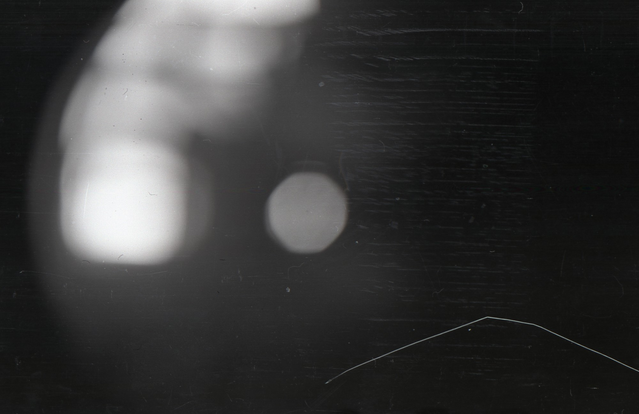

The supplied copy of Frame 34 used throughout this exercise. Source: DYATLOVPASS.COM; this is a reproduced image, not an examination of the original negative.

1. The central polygon: a possible lens ghost

The relatively compact pale shape near the centre looks approximately octagonal to me. My first working interpretation was an internal lens reflection whose boundary is shaped by the aperture, rather than a separate physical object.

I used AI assistance to check the lens information and locate references. Eight-bladed versions of the Industar-22 do exist; some early versions have ten blades. Therefore an approximately eight-sided reflection is compatible with an eight-bladed example, although I have not established the blade count of the particular lens involved here.

An aperture-shaped ghost near the centre is optically possible with an off-centre source. However, we have not calculated or experimentally reproduced this exact reflection in an Industar-22. A separate defocused light could also acquire an aperture-shaped outline. The ghost interpretation is a working assumption, not an identification.

Lens reference: https://radojuva.com/2013/03/obzor-industar-22-3-5-50mm-p/
Ten-bladed early example: https://radojuva.com/2020/07/industar-22-moskva/
General explanation of aperture-shaped ghosts: https://av.jpn.support.panasonic.com/support/global/cs/dsc/knowhow/knowhow15.html

2. Why I questioned a long motion trail

If the whole extended formation on the left were the trail of a compact light moving relative to the lens during a long exposure, I would normally expect its associated ghost to move as well. The central shape remains comparatively compact, with a recognisable polygonal boundary. That made me wonder whether the left-hand formation largely existed at one moment, rather than being drawn entirely by movement during the exposure.

Initially, I assumed handheld night photography without a tripod, and suspected a short exposure with only slight camera shake, perhaps around 1/30 second or faster. I now need to distinguish that initial reasoning from what can actually be established: the photograph does not determine the shutter speed. Some ghosts move less than the main image, and a brief light event can be recorded during a longer exposure. Also, the case-file inventory mentions a camera with 34 exposed frames together with a tripod, so my initial assumption of no tripod is not secure.

The limited claim I retain is that the large left-hand shape need not be a long motion trail. Much of it could represent an extended scene blurred mainly by defocus.

Case-file inventory, sheet 5: https://dyatlovpass.com/case-files-3-6

3. The uneven upper formation

The light above the main bright patch is uneven and lobed, with a darker indentation on the right. It reminded me of smoke illuminated from below. I treated the bright lower area and the upper formation as one related scene: a light source with illuminated material above it.

Smoke was my initial suggestion, not a recovered detail. Illuminated tent fabric, folds, steam or a combination of these could also contribute to the upper formation.

4. The roughly rectangular lower light

What particularly caught my attention was the lower bright area's approximately rectangular outline, with rounded corners. Strong defocus can soften a rectangular light source without making it perfectly circular.

When I raised this point, the AI suggested a bright rectangular opening, including a furnace or stove opening, as one possible explanation. We explored three variants: an incandescent opening with smoke, a rectangular lamp illuminating mist, and several closely spaced lights. The opening-and-smoke version is the one developed below.
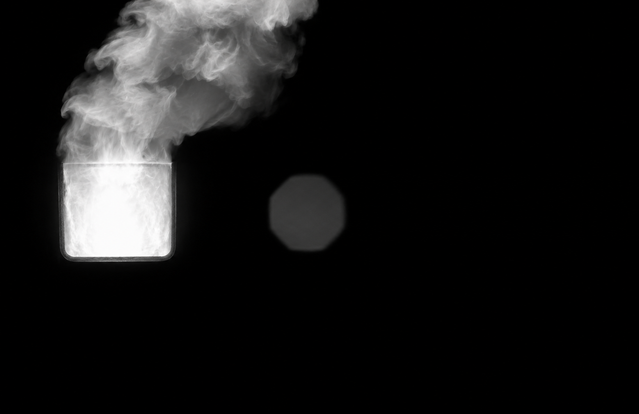

AI-generated hypothetical scene: a bright rectangular opening with illuminated smoke. This version predates the later tilt and lens-rendering adjustments.

5. Introducing a small tilt and slight camera shake

We then rotated that reconstruction about four degrees clockwise, lowering the right side. A separate processed version added defocus and a small diagonal displacement blend to represent slight camera shake. These are illustrative settings, not measurements recovered from Frame 34.
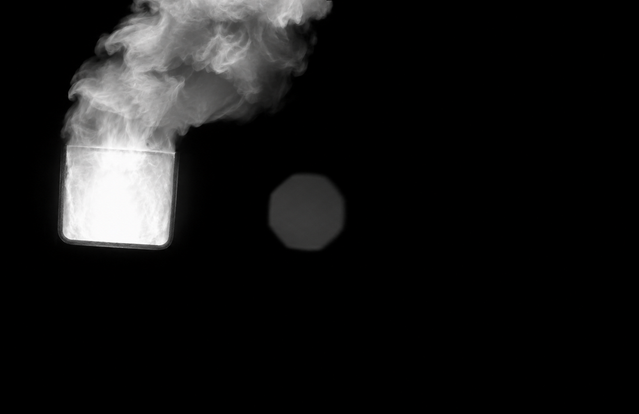

The same hypothetical scene rotated clockwise, before the additional defocus and shake.
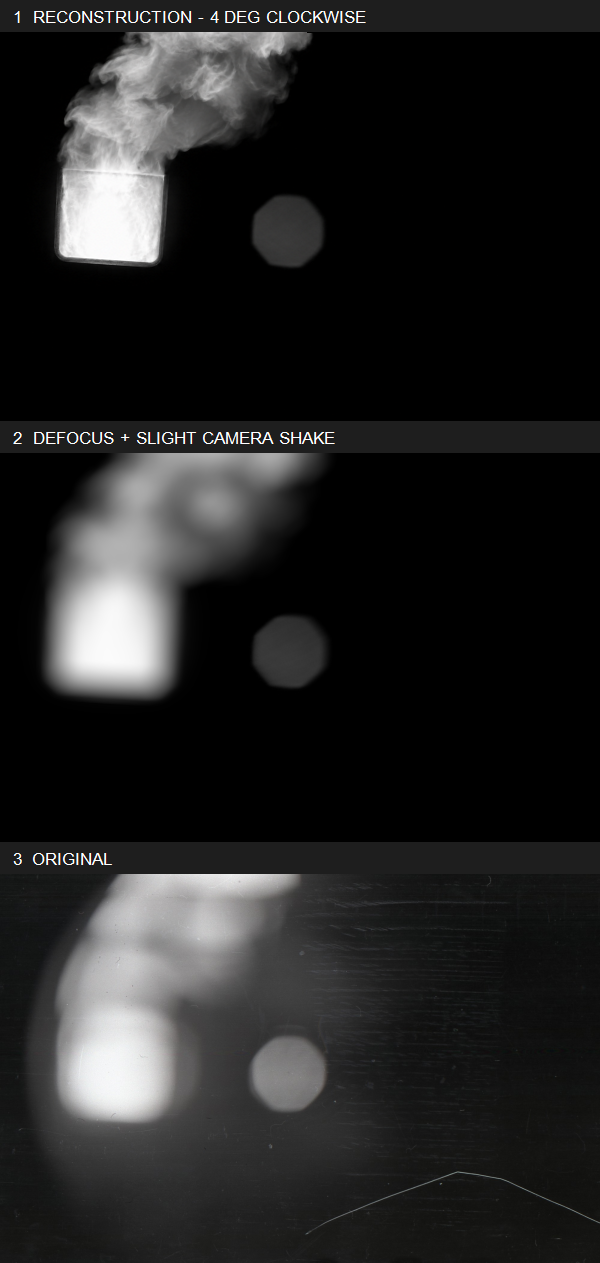

Top: tilted reconstruction. Middle: octagonal defocus plus a small camera-shake blend. Bottom: the supplied copy of Frame 34. The central ghost was assumed and retained separately during defocus; it was not generated by ray tracing.

6. An approximate Industar-22 rendering

We also made an AI-generated version intended to reflect some reported characteristics of the Industar-22: softer bright boundaries, reduced contrast against an intense light source, and veiling glare. These characteristics vary with the lens version, aperture and individual condition. We then applied defocus and slight shake computationally, as before.

This is an approximate imitation of the lens's rendering, not a calibrated optical simulation. The working prompt assumed an eight-bladed version at f/5.6; neither that aperture nor the actual focus setting is known. Chromatic aberration was not independently calculated. The central ghost's position and brightness were assumed, not predicted.
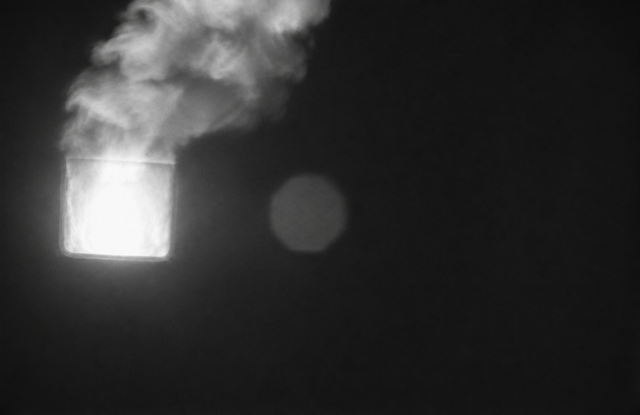

Hypothetical reconstruction with an approximate vintage Industar-22 rendering.
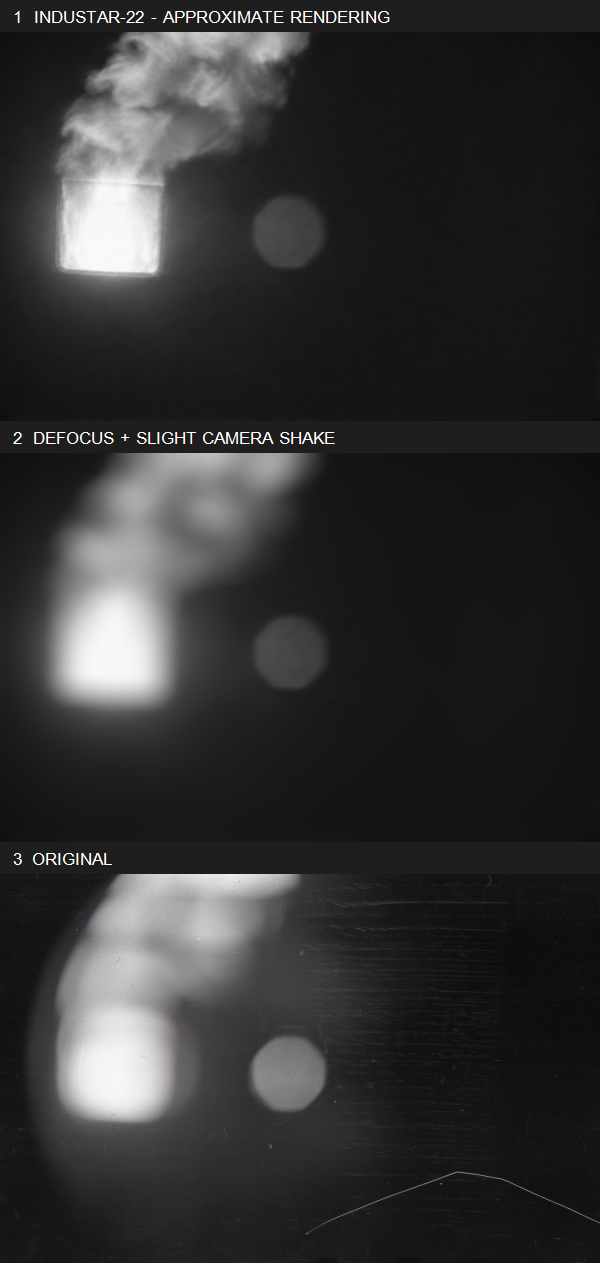

Top: approximate Industar-22 rendering. Middle: the same reconstruction with added defocus and slight shake. Bottom: Frame 34.

7. Finding photographs of a stove replica afterwards

Only after we had discussed the rectangular opening and generated the stove-like reconstruction did I find the following photographs on DYATLOVPASS.COM. The article also includes a stove-replica demonstration credited to Aleksandr Fedotov, February 2025.

Source article: https://dyatlovpass.com/firewood-in-the-tent-ru
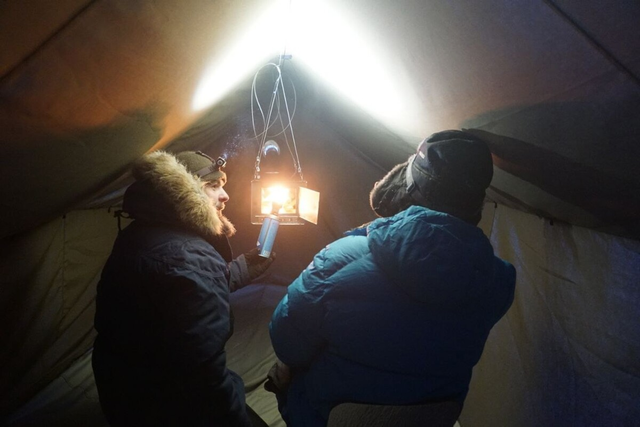

Contemporary tent-and-stove reconstruction photograph reproduced from DYATLOVPASS.COM, with source credit. This is not a photograph of the original 1959 scene.
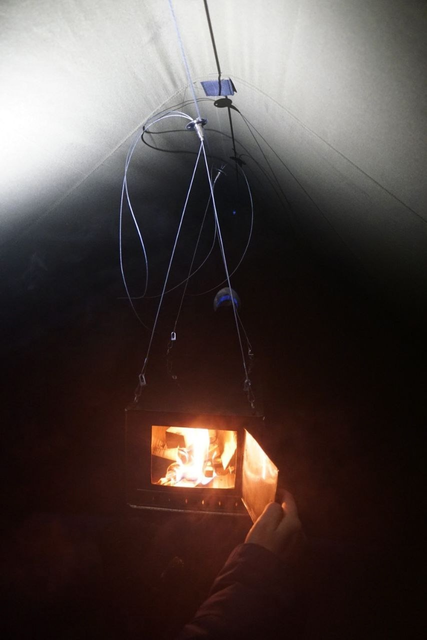

A closer view supplied from the same article. The bright rectangular opening and illuminated tent fabric provide a concrete scene worth testing photographically. Source: DYATLOVPASS.COM.

The resemblance struck me: a rectangular fire-lit opening below, with irregular illumination spreading above it. In these modern photographs there are additional lights, so they are not a direct reproduction of the lighting proposed for Frame 34. Nevertheless, they suggest a practical test using the stove as the main light source, with the other lights switched off.

What this exercise does and does not show

The goal was to imagine a physically plausible scene, not to recover hidden detail or force every patch into an exact match. However, the generated images were explicitly guided by the original's positions and broad light contours. Their resemblance is therefore not independent evidence that a stove was photographed.

The source photograph's upper formation is more uniformly bright than our simulated smoke, and its lower bright patch is less regular. Its broad curved light boundary on the left also remains unexplained. Tent illumination, optical reflections and film or reproduction effects need to be distinguished rather than treated as interchangeable explanations.

There is also a historical constraint: Lebedev's testimony describes the stove in its case with the pipes inside it. My hypothesis does not establish that the stove was lit at the final campsite, or when this frame was exposed. It should not be used as evidence of a stove accident.

Lebedev's testimony: https://dyatlovpass.com/case-files-313-315

My question is narrower: could a bright stove opening and illuminated tent fabric and/or smoke, photographed out of focus, produce the broad structure of Frame 34?

I would welcome photographic objections, information about the actual stove and camera, and especially a practical test with an Industar-22. Reproducing the left-hand light formation and the central polygonal ghost together, rather than placing the ghost into a reconstruction, would be particularly informative.

All reconstructed scenes above are AI-generated illustrations. The subsequent defocus, rotation and shake processing were performed computationally. None of these images is recovered photographic evidence. For the illustrations, scratches and dust were omitted, and the thin angular line at the bottom right was treated as a possible surface defect; that classification has not been established from the negative.

 

November 19, 2026, 03:11:09 PM
Reply #1
Online

Ziljoe


Nice work.

This would be something that someone with the appropriate resources could maybe replicate.

I haven't looked at all your links yet. There is a link on the main website to the camera and it's aperture. I'm not sure if the smoke would be captured with such intensity but I'm no expert .

However, there's is room to assume the stove had been used but the incident took place in the morning and perhaps the stove had been dismantled. The last shot could have been an chance shot to finish the film . I don't think it was reported if that sequence of film had been rewound, found in the camera or separate.

A really interesting way to look at the potential of what the photo might of been and gives food for thought .

A lot of interesting posts of late. Great!!!
 
The following users thanked this post: p281730

November 19, 2026, 11:16:16 PM
Reply #2
Online

Ziljoe


Just following up on this after checking the inventory in Volume 2 — there are a few small details in the case file that actually fit your hypothesis quite neatly:

First, Krivonischenko's Zorki (№488797) is listed three separate times with the tripod (Sheets 17b, 42, and 45), and Sheet 17b explicitly notes "film №1 from Zorkiy 488797 with tripod attached." It would have been one of those small, telescopic pocket tripods (or a clamp mount) rather than anything bulky, so if it was still screwed onto the camera body when recovered, it suggests the camera was actively set up for a low-light shot rather than packed away in a rucksack. Those little threads are fiddly to attach when your hands are cold.

Second, Sheet 42 notes that 34 frames were shot on that roll (with Sheet 17b also mentioning three missing/blank frames, which is normal for loading leaders on a bottom-loading Zorki), and Frame 34 sits right at the end of the sequence immediately following the shots of the group ascending the snow slope.

This suggests the shot of frame 34 was taken and most likely in a controlled manner.

It makes me wonder if the stove was actually used overnight (supported by the two skis found outside the tent entrance) and the incident happened early in the morning while it was still dark. Someone could have had the stove door open while another person shone a torch or held a candle near the camera — bouncing light off smoke or steam while the out-of-focus firebox created the bright rectangular shape and lens ghost, right as Krivonischenko finished off the last frame on the roll. They may have then dismantled and packed the stove away as part of morning preparations right before the incident occurred.

As you said, you probably wouldn't even need an exact 8-bladed Industar-22 to test the basic mechanics — any manual film camera with a focusing lens set out of focus at close range against a stove opening and a side light would be a great experiment to see how close it gets.
 

Today at 03:14:17 AM
Reply #3
Online

Axelrod


It makes me wonder if the stove was actually used overnight (supported by the two skis found outside the tent entrance) and the incident happened early in the morning while it was still dark.

I am firmly of the opinion that the Dyatlov group left their tent on the evening of February 1st.
This is because they did not manage to make entries in their diaries for that day, and they left their food in a state of disarray.
This is also mentioned in a radiogram dated March 1st.

The idea that they left on the morning of February 2nd likely stems from the interrogation of my relative, Moisey Akselrod.
That took place toward the end of April, by which time he had forgotten everything that had been established. It is possible that he had begun to entertain his own delusional theories.
Since he has since passed away, I cannot speak on his behalf—but my own view is different now. I wish to caution you against the points on which he was completely mistaken.
There are more things in heaven and earth, Horatio, than are dreamt of in your philosophy.
 

Today at 03:23:25 AM
Reply #4
Offline

p281730


Hello.

Thank you very much for your reply and your kind words.
I really didn’t set out to make the result match the original photo, and I found the result very impressive myself.

Here’s what else I can add regarding the shooting conditions and the technical aspects of the photo.

1. I’m convinced the photo was taken at night. It’s quite difficult to explain this, but it’s down to the contrast between the light and dark areas. My theory is that the light sources in the photo are overexposed. If it had been taken during the day, we would not normally be able to find a perfectly dark room, so with such overexposure of the light sources, the remaining dark areas would contain some detail in the image, which is not the case here. To illustrate the opposite scenario – if the photo were taken during the day with normal exposure, yes, the remaining areas would be extremely dark, but the light source would still contain some relatively distinguishable detail, even if it were out of focus.

2. For me, the key clues are the octagonal spot in the centre, as well as the relatively rectangular light source to the left of it. If you take any camera with an aperture, set it to full defocus and point it at any ordinary light source (a torch, a light bulb, a candle, a star, the moon or a rocket), it is impossible to obtain a rectangular outline of the light source on Industar-22.

3. As for the smoke and its brightness. I can easily imagine a scene like the one in the reconstruction, provided that the smoke is rising not only upwards but also towards the photographer. In other words, the light from the stove is not shining vertically upwards, but in all directions from its window. Consequently, with this exposure, it was the smoke that stood out, whilst the dark areas around it most likely also emphasise that this was the only light source at the time the photograph was taken.

4. Halos and blurring around the light source. Several factors are likely to have played a part here – the lens, the shooting conditions, and, very importantly, the film itself. We do not know exactly what condition the film was in at the moment the photograph was taken. Both low and high temperatures could have affected how the film reacted to the exposure, as well as the development process.

5. My experience of working with soviet cameras (I’ve taken quite a lot of photographs with the Zenit and the FED – the camera most similar to the Zorkiy, Lyubitel and Sputnik) suggests to me that every individual camera from that era was unique. Differences in the manufacture of the same model were significant enough for even identical models to produce unpredictable artefacts in the photographs.

6. If a tripod was used after all, the exposure time might have been longer, and this could also explain the excessive brightness of the smoke caused by the layers overlapping under the light.

I’d also like to add a point regarding the stove itself – I personally have no experience of camping, but it strikes me that assembling the stove in the morning (before you eat and take clothes) is an extremely illogical thing to do. Mind you, just like every other detail of the official investigation. If we assume that the incident occurred on the same night (when the photograph was taken), that there really was a stove in the photograph, and that the stove was found fully assembled – in my view, this completely undermines all the official findings of the investigation, because we can no longer establish what constituted a fact relating to the incident.

It is not my intention to cast doubt on the case files; however, it seems to me that the main reason so many people are investigating this topic lies in the fact that most of the facts contradict one another or appear inexplicable from a logical point of view.

Thank you very much for your attention to my post.

Best regards
« Last Edit: Today at 03:41:52 AM by p281730 »
 

Today at 04:39:41 AM
Reply #5
Online

Ziljoe


p281730, your point about a longer tripod exposure allowing overlapping layers of smoke to build up brightness makes a lot of sense, especially with the smoke rising toward the lens.
Just to clarify one small detail about the stove (which may have been a translation mix-up): when searchers found the tent, the stove was dismantled and packed away inside its case—not hanging assembled (depending on the witness account, either with the chimney pipes stowed inside or a piece of firewood inside). While winter groups did often run these stoves overnight, if the wind picked up strongly on the slope, taking a suspended metal stove down so it wouldn't swing against the canvas is completely logical and doesn't contradict Lebedev's testimony at all.
And Axelrod, that fits an evening timeline on February 1st just as well—lighting the stove for warmth and supper after pitching camp, snapping Frame 34 on the tripod, and dismantling the stove before settling down for the night.

It's food for thought and it's as good a theory for what the image might be. It certainly resembles the example . I have done winter camping with a stove and you can get a nice puff of smoke coming out.
 
The following users thanked this post: p281730

Today at 07:34:24 AM
Reply #6
Online

GlennM


Images 1 to 33 on this roll of film show well composed and properly exposed daylight shots. Image 34 is completely inconsistent with the previous pictures. I believe that muscle memory and practice would prevent Zolo from taking such a picture. He would have instinctively composed a photo because he understood the value of a photo as well as the expense of developing a roll of film.

The suggestion in DyatlovPass.com that the camera was pre wound with the trigger set makes sense to me.  This means that Zolo could compose a photograph without removing the camera from his eye in order to advance the film. If on the other hand, the camera was not wound,  then the time lost by advancing the film results in a poorly shot candid photo.

I believe frame 34 is an artifact. The person who developed the film could not get it out of the camera unless the camera was triggered. I think this was done in a darkroom with the deliberate intention of making it unmistakenly different from the orevuous 33 exposures. I also believe it was included in the case files because it is easire to include each and every exposure as opposed to having to explain a throw away exposure. That would simply trigger everyone who favors a conspiracy, then and now.
We don't have to say everything that comes into our head.
 
The following users thanked this post: p281730

Today at 08:25:14 AM
Reply #7
Offline

p281730


Images 1 to 33 on this roll of film show well composed and properly exposed daylight shots. Image 34 is completely inconsistent with the previous pictures. I believe that muscle memory and practice would prevent Zolo from taking such a picture. He would have instinctively composed a photo because he understood the value of a photo as well as the expense of developing a roll of film.

The suggestion in DyatlovPass.com that the camera was pre wound with the trigger set makes sense to me.  This means that Zolo could compose a photograph without removing the camera from his eye in order to advance the film. If on the other hand, the camera was not wound,  then the time lost by advancing the film results in a poorly shot candid photo.

I believe frame 34 is an artifact. The person who developed the film could not get it out of the camera unless the camera was triggered. I think this was done in a darkroom with the deliberate intention of making it unmistakenly different from the orevuous 33 exposures. I also believe it was included in the case files because it is easire to include each and every exposure as opposed to having to explain a throw away exposure. That would simply trigger everyone who favors a conspiracy, then and now.

I agree with you on many points. However, technically, it is possible to take such a photograph without exposing the film – with the lens covered or just in dark space without light and source of light in the frame.
If I were part of the investigation, I would never have taken any visible photograph in order to retrieve the film, as this only causes further confusion; and, as far as I am aware, no such evidence exists. Although we’re talking about the late 1950s in the Soviet Union, so who knows...
 

Today at 08:42:06 AM
Reply #8
Online

bongyi


Hi! Nice work and really thought provoking!
The first question that occurred to me was whether it is conceivable that the smoke will flow back from the stove like this? So, by opening the stove door, the air does not flow towards the chimney, but in the direction of the door and through it into the tent?
The other question is, could this have been an accidental photograph? Was there any intention in taking a picture of the stove with the door open? It would undoubtedly be valuable information if we had pictures of the internal conditions of the tent, including the stove in its installed and working condition. But such images are not known. Presumably there are no such pictures for a reason!

In general, the facts about the photographs of the case are important:

1) Pictures taken on this tour will be found that are not included in any of the inventoried negatives, and their origin is completely unknown. We call these Loose-photos!

2) The film negatives found in the cameras found in the tent on February 26 will be handed over to the searchers by the prosecutor leading the investigation, Lev Ivanov, in order to develope them. By doing so, Ivanov violates the rules for handling evidence, risking the final destruction of evidence. Prosecutors' offices have been equipped with photographic technology labs since 1954 and are able to develop negatives themselves. There is documentation about this transfer, specifically the negative in question, which is found in Krivonischenko's camera. : https://dyatlovpass.com/bienko
This is a very problematic part of what is happening that cannot be explained simply. I have a theory about this, which I will spare the readers here. But the questions remain here: How can the prosecutor hand over evidence to unauthorized civilians? How could he pass on the film negatives when the evidence could be permanently destroyed in the event of an error during development? The solution to the whole case can be in the photos and a prosecutor would risk that? Why is Ivanov handing over Krivonischenko's film negative to Bienko? There are the negatives, on what basis did you choose this one from the others, that it is very urgent to call it up?
So _NO_! Something is VERY WRONG here!

3) One of the searchers secretly takes one of the cameras found in the tent along with the film negative inside. He must return these later when it becomes clear what he did.


The explanation on the page regarding the exposure of frame #34 [sometimes: #33], which I have not been able to fully understand, is that this is an exposure due to a technical reason that was not made on the tour: https://dyatlovpass.com/controversy?lid=1&flp=1#frame34
The memory of the victims obliges us not to talk nonsense!